


Behind the Grass Monitor
How SFR uses grass quality data
What happens out in the field has a direct impact on a cow’s ration. The composition and nutritional value of fresh grass change throughout the season, making up-to-date information highly valuable to dairy farmers and feed advisers. This is why the Grass Monitor is featured weekly in Veeteelt, with Schothorst Feed Research (SFR) as one of the organisations contributing to it.
But what exactly is SFR’s role, and how does the company use the underlying data? We asked Wilfried van Straalen, Senior Consultant Ruminant Nutrition at SFR, who has been responsible for SFR’s commentary on the Grass Monitor for many years.

What exactly is the Grass Monitor, and where does SFR come in?
“The Grass Monitor is Veeteelt’s weekly update on the quality of fresh grass in the Netherlands. It uses grass samples from Vers Gras, a collaborative network that SFR has been part of for around fifteen years. Five compound feed companies also participate in the network. The samples are analysed by Eurofins. Experts from the participating companies then review the results and take turns sharing their insights for the Grass Monitor. On behalf of SFR, I provide this commentary approximately once every four to five weeks.”
So, SFR contributes to the Grass Monitor, but do you also use the data yourselves?
“Absolutely. We use the data for much more than just our regular commentary for the Grass Monitor. For example, we use the multi-year dataset in our consultancy work, as well as for our Zootechnical Support programme. This is a recurring training programme in which we update our customers’ field staff on the latest developments and knowledge in animal nutrition.
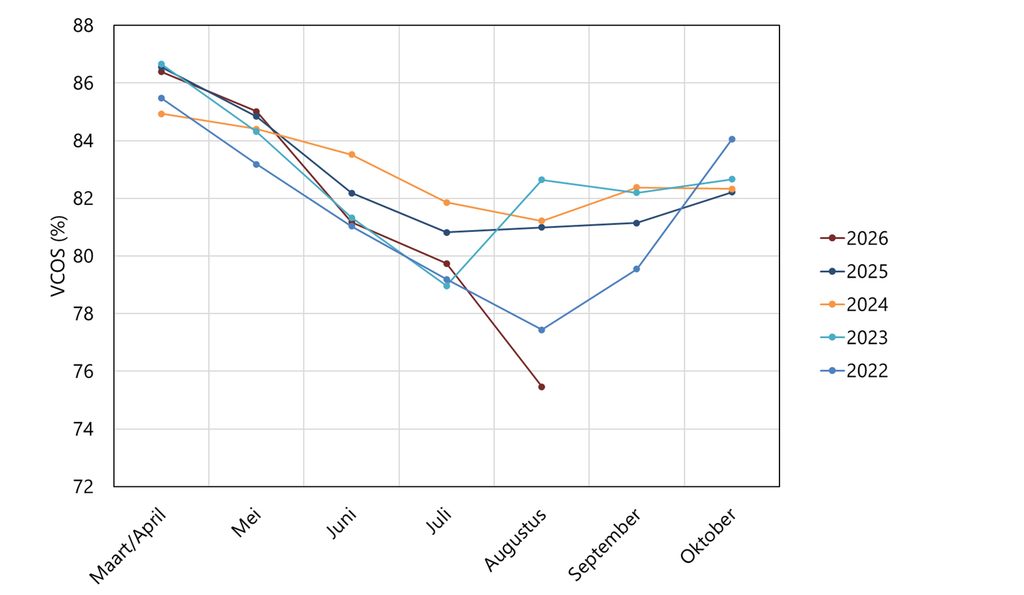
The grass data make these developments very tangible. For example, we can show how the protein content and digestibility of grass change throughout the season. And because we have data covering multiple years, we can also clearly compare the current grass-growing season with previous years.”
What stands out about this year’s grass?
“The effects of this summer’s drought are clearly reflected in the data. Digestibility is towards the lower end of what we have seen over the past five years, comparable to 2021 and 2022. There is currently little grass available, and what is there is less digestible. As a result, cows get less nutritional value from the grass and dairy farmers need to provide more supplementary feed.
Some farmers are already having to use their winter feed stocks earlier than usual. Fortunately, growing conditions were favourable in spring and many farms achieved a good first cut, but that feed was, of course, intended for the winter.”
Does SFR’s own grass research go a step further than the joint monitoring programme?
“Yes, that is a separate research programme. In our own field trials, we study grass grown at different nitrogen levels and also look at combinations with white and red clover, as well as lucerne. We use these insights to update our equations for determining the nutritional value of grass. Some of these equations are still based on data from several decades ago, when grass received much higher levels of nitrogen fertilisation than it does today.”
What exactly does this update involve?
“We combine laboratory measurements with new trials on almost two hundred grass samples. We investigate how the grass is broken down and how this relates to its composition. This gives us a more up-to-date and accurate picture of digestibility and enables us to better predict the nutritional value of today’s grass.”
The combination of joint monitoring and SFR’s own research provides valuable practical knowledge about grass quality. We use these insights to give our customers targeted advice on what changes in grass quality mean for the ration, both now and in the future. As growing conditions change, it is important that our knowledge of what happens in the grass continues to develop as well.
In this way, the Grass Monitor provides an up-to-date picture of what is happening out in the field, while SFR’s own research continues to build knowledge about the nutritional value of grass. Together, these insights provide a strong foundation for practical and up-to-date nutritional advice.
Source citation: https://veeteelt.nl/versgrasupdate/versgrasupdate-met-24-procent-droge-stof-droogt-gras